
Serum and night cream may look like two moisturising steps, but they are not designed to do the same job.
A serum is usually lighter, more targeted and formulated to deliver specific active ingredients.
A night cream is typically richer and designed to provide moisturisation, barrier support and comfort over the overnight period.
Used together, they can create a more complete evening routine.
Why Layering Matters
Layering matters because different product formats are designed to sit at different points in the routine.
A serum usually comes first because it is lighter.
A night cream follows because it is richer and helps provide a final moisturising layer.
The basic sequence is:
Cleanse → Serum → Night Cream
This keeps the routine simple and logical.
What Does a Serum Do?
A serum is typically designed to deliver targeted ingredients in a lightweight format.
Depending on the formulation, a serum may focus on:
- hydration
- firmness
- visible fine lines
- elasticity
- uneven texture
- dullness
- overall skin quality
Because serums are generally lighter, they are usually applied before creams.
What Does a Night Cream Do?
A night cream is designed to provide moisturising support during the overnight period.
Its main roles may include:
- reducing moisture loss
- supporting the skin barrier
- improving softness
- improving surface smoothness
- increasing comfort
- helping skin look fresher by morning
The purpose is not to replace the serum.
It is to complement it.
Why Not Use Only One Product?
You can.
Some people may prefer a minimal routine with only a serum or only a moisturiser.
But if your goals include both targeted anti-ageing support and overnight moisturisation, using both can make sense.
The serum addresses more targeted concerns.
The night cream supports hydration and the barrier.
Why Does Serum Come First?
The general skincare rule is to apply products from lighter to richer texture.
Serums are usually more fluid and designed to sit closer to clean skin.
Night creams are richer and are usually applied after serum.
This helps avoid placing a heavy layer underneath a lighter product.
Does Night Cream “Lock In” Serum?
The phrase “lock in” is commonly used in skincare, but it is a simplified way of describing what happens.
A night cream does not literally seal serum inside the skin.
More accurately, it can help reduce moisture loss and provide a moisturising layer over the skin.
This may help maintain comfort and hydration after serum application.
Why Is Hydration Important After Serum?
Some active serums are not designed to provide enough moisturisation on their own.
Following with a night cream can help:
- reduce dryness
- improve comfort
- support the barrier
- improve softness
- maintain hydration overnight
This is especially useful for skin that becomes dry or tight by morning.
What Happens If You Use Night Cream Before Serum?
Applying a richer cream first may make it harder for a lighter serum to spread evenly over the skin.
That is why serum is usually applied first.
The simpler sequence is:
Cleanse → Serum → Cream
Should You Wait Between Layers?
You usually do not need to wait a long time.
Allow the serum to settle briefly, then apply night cream.
The exact timing depends on the product texture.
The routine should remain practical enough to repeat every night.
Can Layering Improve Skin Hydration?
Yes.
Using a hydrating serum followed by a moisturising cream can provide multiple layers of hydration support.
The serum may help attract and hold water.
The cream may help reduce moisture loss and support the barrier.
Together, they can help the skin appear:
- smoother
- softer
- plumper
- more supple
Why Does This Matter More for Ageing Skin?
As skin ages, it may become more prone to:
- dryness
- reduced moisture retention
- visible fine lines
- loss of firmness
- rough texture
Combining targeted skincare with moisturisation can help address several of these concerns within one routine.
What Happens to Skin While You Sleep?
The skin remains active overnight.
It continues to regulate moisture, maintain barrier function and carry out normal recovery and renewal processes.
For more detail, read What Happens to Your Skin While You Sleep?
Why Overnight Hydration Matters
The skin continues to lose water while you sleep.
For ageing skin, this may become more noticeable as barrier function and water-retention capacity change over time.
For a deeper explanation, read Why Overnight Hydration Matters for Ageing Skin
Night Cream vs Moisturiser
A night cream and a moisturiser can overlap in function.
The main difference is that a night cream is usually designed specifically for the evening and may provide more sustained moisturisation.
For the full comparison, read Night Cream vs Moisturiser: What’s the Difference?
How Does AGE REWIND Fit Into the Routine?
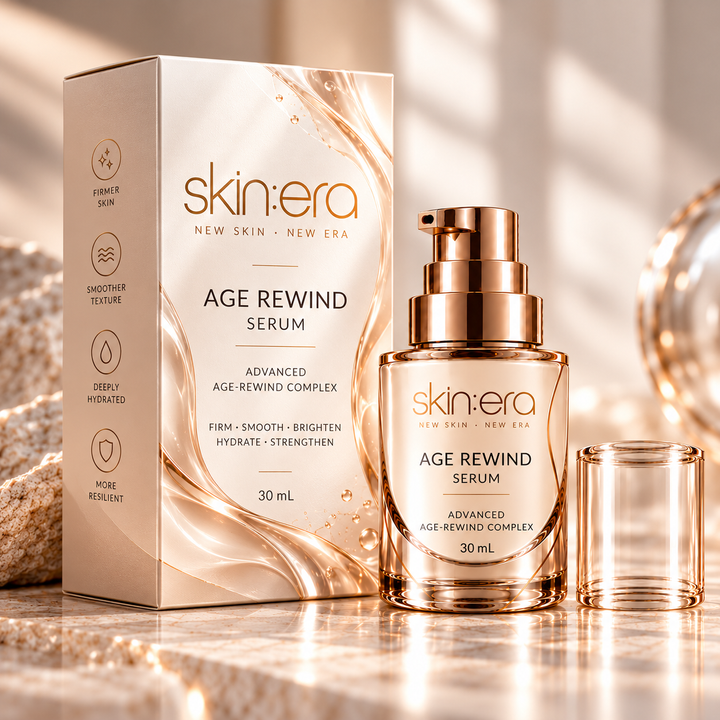
SKINERA AGE REWIND SERUM is designed to support firmer, smoother, hydrated and more resilient-looking skin.
It is used after cleansing and before night cream.
How Does AGE RESTORE Fit Into the Routine?
SKINERA AGE RESTORE CRÈME — NIGHT SHIFT is designed to be the final moisturising step at night.
Its role is to support:
- overnight hydration
- softness
- smoothness
- comfort
- a fresher and more rested-looking appearance by morning
Why AGE REWIND + AGE RESTORE Work as Two Different Steps
The two products are not duplicates.
AGE REWIND is the targeted serum step.
AGE RESTORE is the final moisturising step.
Together, they create a simple night routine:
Cleanse → AGE REWIND → AGE RESTORE
Each product has a different role.
Can You Use AGE REWIND Without AGE RESTORE?
Yes.
Some skin types may find the serum alone comfortable enough.
However, if your skin feels dry, tight or dehydrated by morning, following with AGE RESTORE can provide additional moisturising support.
Can You Use AGE RESTORE Without AGE REWIND?
Yes.
AGE RESTORE can still provide moisturisation on its own.
However, using it after AGE REWIND creates a more complete routine for users who want both targeted serum care and overnight moisturisation.
How to Build an Effective Anti-Ageing Night Routine
A simple routine is usually easier to maintain than a complicated one.
For a full step-by-step guide, read How to Build an Effective Anti-Ageing Night Routine
What About Hydrogel Masks?
A hydrogel mask can be added on selected treatment nights.
A treatment-night sequence may look like:
Cleanse → Hydrogel Mask → Serum → Night Cream
This adds an extra hydration-focused step without changing the core daily routine.
Can Too Many Layers Be a Problem?
Yes.
Using too many products can increase:
- pilling
- heaviness
- discomfort
- irritation risk
More layers do not always mean better results.
A focused routine is usually easier to maintain consistently.
Why Consistency Matters More Than Complexity
The most effective routine is one you can repeat regularly.
Using serum and night cream consistently gives the skin repeated support over time.
This is more useful than occasionally using many products at once.
What About the Morning Routine?
The morning routine has a different final step.
Instead of night cream, sunscreen becomes the priority.
A simple SKINERA morning routine is:
Cleanse → AGE REWIND → AGE DEFEND
The night routine is:
Cleanse → AGE REWIND → AGE RESTORE
This creates a clear day-and-night structure.
Why Sunscreen Still Matters
Even the best night routine cannot compensate for repeated UV exposure.
Daily sunscreen remains one of the most important parts of an anti-ageing skincare strategy.
For more detail, read Why Sunscreen Is One of the Most Important Anti-Ageing Products
The Bottom Line
Serum and night cream are not the same step.
A serum provides targeted skincare in a lighter format.
A night cream provides moisturisation, barrier support and overnight comfort.
Used in the correct order, they complement one another.
For SKINERA, the core night routine is:
Cleanse → AGE REWIND → AGE RESTORE
Serum first.
Night cream last.
Simple layering with two different roles.