
What Is PDRN in Skincare? Benefits, How It Works & Who It’s For
PDRN has become one of the most talked-about ingredients in advanced skincare and aesthetic medicine. Often associated with skin renewal, smoother-looking texture and improved skin quality, PDRN is increasingly appearing in modern anti-ageing formulations.
But what exactly is PDRN, how does it work, and what can it realistically do for the appearance of your skin?
Here is what you need to know.
What Is PDRN?
PDRN stands for polydeoxyribonucleotide.
It is made up of purified DNA-derived fragments known as nucleotides. In dermatology and regenerative research, PDRN has attracted attention because of its potential role in supporting biological processes associated with tissue repair and skin recovery.
Research suggests that PDRN may interact with pathways involved in cellular activity, extracellular-matrix maintenance and tissue regeneration. However, the exact effects can vary depending on the formulation, molecular characteristics, concentration and method of delivery.
This is why PDRN is increasingly being explored not only in professional aesthetic treatments, but also in advanced topical skincare.
Why Is PDRN Becoming Popular in Skincare?
Skin naturally changes with age.
Over time, factors such as UV exposure, environmental stress, reduced moisture retention and changes in collagen and elastin can contribute to:
- loss of firmness
- fine lines
- rough or uneven-looking texture
- dullness
- reduced elasticity
- dry or dehydrated skin
- a less resilient-looking complexion
PDRN has gained attention because research into polynucleotides and PDRN suggests potential benefits relating to skin quality, tissue repair and rejuvenation.
Recent reviews have reported promising results for wrinkle appearance, skin quality and regenerative applications, although researchers also note that larger and more standardised studies are still needed.
How Does PDRN Work?
PDRN is thought to support several biological pathways associated with skin recovery and tissue function.
One proposed mechanism involves adenosine A2A receptor activity, while other research has explored its role in nucleotide salvage pathways and cellular repair processes.
In practical skincare terms, the interest in PDRN centres around its potential to support an environment where skin can appear:
- smoother
- healthier
- more resilient
- better hydrated
- more refined
It is important to distinguish between supporting the appearance and condition of skin and making medical claims about healing or regeneration.
For cosmetic skincare, the goal is to improve the visible quality of the skin rather than treat a disease or medical condition.
What Are the Potential Benefits of PDRN in Skincare?
1. Supports Smoother-Looking Skin
One of the main reasons PDRN is used in anti-ageing skincare is its potential to support a smoother and more refined-looking complexion.
Research into PDRN and related polynucleotide technologies has reported improvements in several skin-quality parameters, although outcomes vary between studies and treatment methods.
2. Supports Firmer and More Resilient-Looking Skin
Ageing and repeated environmental exposure can affect the extracellular matrix — the structural network that helps support the skin.
Research has explored the potential relationship between PDRN and pathways involved in extracellular-matrix maintenance, including collagen-related activity.
For skincare users, this makes PDRN particularly interesting in formulations designed for skin that is beginning to look less firm or elastic.
3. Helps Improve the Appearance of Fine Lines
Fine lines are influenced by multiple factors, including ageing, UV exposure, dryness and structural changes within the skin.
PDRN is not an instant wrinkle eraser.
However, some clinical research involving polynucleotide and PDRN-based interventions has reported improvements in wrinkle-related outcomes and overall skin appearance.
When used as part of a complete anti-ageing routine, PDRN may therefore be useful for people looking to support smoother, younger-looking skin over time.
4. Supports Hydrated, Healthier-Looking Skin
Hydration plays a major role in how youthful skin looks.
Well-hydrated skin typically appears:
- smoother
- plumper
- softer
- more luminous
PDRN is therefore often paired with complementary hydrating and barrier-supporting ingredients rather than being used alone.
A well-designed formulation should address multiple aspects of skin ageing at the same time.
5. Supports Skin Exposed to Environmental Stress
UV exposure is one of the major contributors to premature visible skin ageing.
Emerging research on topical PDRN has specifically investigated photodamaged skin and extracellular-matrix support, suggesting that topical delivery may have potential in this area. However, research is still developing and results from one formulation should not automatically be applied to every PDRN product.
This is another reason PDRN should be used as part of a complete routine that includes daily broad-spectrum sunscreen.
Is Topical PDRN the Same as Injectable PDRN?
No.
This distinction is very important.
PDRN and polynucleotide treatments used in aesthetic clinics may be delivered through professional procedures, while skincare products are applied topically to the surface of the skin.
The way an ingredient reaches the skin can influence its biological availability and effects.
Therefore, results associated with injectable PDRN should not automatically be assumed to apply to topical skincare.
Research into topical delivery is developing, including recent studies examining specific PDRN preparations and their ability to reach viable skin layers.
For consumers, this means the quality of the formulation matters — not simply whether the word “PDRN” appears on the ingredient list.
Who May Benefit From PDRN Skincare?
PDRN-based skincare may be particularly relevant for people concerned about:
- early visible signs of ageing
- fine lines
- loss of firmness
- uneven-looking texture
- dull or tired-looking skin
- dehydration
- reduced skin resilience
- skin affected by environmental exposure
It may also appeal to people who want to build a more advanced anti-ageing routine without relying on a single ingredient.
At What Age Should You Start Using PDRN?
There is no universal age at which everyone needs PDRN.
Skin ageing is influenced by genetics, lifestyle, UV exposure, environment and skincare habits.
Some people may begin introducing advanced anti-ageing skincare in their late 20s or 30s, while others may start later.
Instead of focusing only on age, consider the visible concerns you want to address.
If your skin is beginning to show dryness, reduced elasticity, dullness or fine lines, a well-formulated anti-ageing serum may be worth introducing.
How Should PDRN Be Used in a Skincare Routine?
For a topical serum, the general order is:
Cleanse → Serum → Moisturiser → Sunscreen in the morning
At night:
Cleanse → Serum → Night Cream
For the SKINERA routine:
Morning:
SKINERA AGE REWIND SERUM → SKINERA AGE DEFEND FLUID SPF50+ PA++++
Night:
SKINERA AGE REWIND SERUM → SKINERA AGE RESTORE CRÈME — NIGHT SHIFT
This approach combines targeted serum care with daytime UV defence and overnight moisturising support.
Why PDRN Works Best as Part of a Complete Formula
A common mistake in skincare is focusing too heavily on one “hero ingredient.”
Skin ageing is complex.
For this reason, advanced formulations often combine multiple ingredients that address different aspects of skin appearance, such as:
- hydration
- barrier support
- antioxidant care
- skin tone
- elasticity
- texture
- moisture retention
PDRN can therefore be viewed as part of a broader formulation strategy rather than a standalone solution.
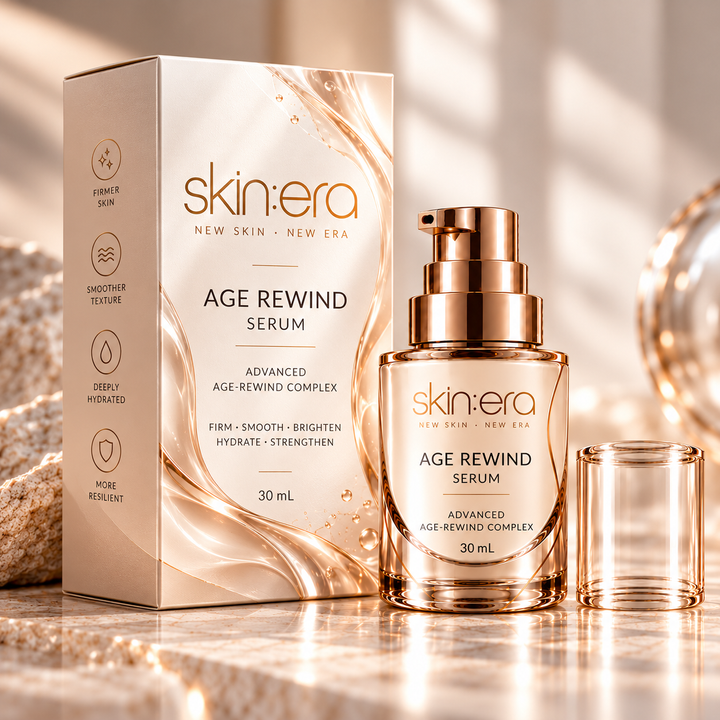
PDRN in SKINERA AGE REWIND SERUM
SKINERA AGE REWIND SERUM is designed as an advanced daily anti-ageing serum featuring PDRN alongside a carefully selected multi-active system.
The formula is developed to support:
- firmer-looking skin
- smoother texture
- hydration
- skin resilience
- a more refined and youthful-looking appearance
Rather than relying on PDRN alone, AGE REWIND combines it with complementary skincare ingredients as part of a broader anti-ageing formulation.
Explore SKINERA AGE REWIND SERUM:
PDRN and the Future of Advanced Skincare
PDRN is an exciting area of modern skincare science, but it is also an area where responsible communication matters.
Current research is promising, particularly in regenerative dermatology and skin-quality applications, but the evidence base continues to evolve. Reviews consistently note the need for larger, better-standardised clinical trials.
For consumers, the most important consideration is not simply choosing a product because it contains PDRN.
Instead, look at the complete formulation, how the product fits into your routine and whether it addresses the specific needs of your skin.
The Bottom Line
PDRN is a DNA-derived skincare ingredient attracting growing attention for its potential role in supporting smoother, firmer, healthier and more resilient-looking skin.
Its real value is likely to be strongest when it is incorporated into a thoughtfully designed skincare formula and used consistently alongside hydration, barrier care and daily UV protection.
For anyone building a more advanced anti-ageing routine, PDRN represents one of the most interesting emerging areas in modern skincare science.