
PDRN for Skin: What Does It Actually Do?
PDRN has quickly become one of the most discussed ingredients in modern anti-ageing skincare.
But beyond the trend, one important question remains:
What does PDRN actually do for the skin?
The answer is more nuanced than simply saying that PDRN “repairs” or “rejuvenates” skin.
Research into PDRN suggests that it may support biological pathways associated with tissue recovery, cellular activity and skin quality. However, its effects depend heavily on the type of PDRN used, the formulation, concentration and method of delivery.
Here is a clearer look at what PDRN may actually do for the appearance and condition of skin.
What Does PDRN Do in the Skin?
PDRN stands for polydeoxyribonucleotide.
It is a DNA-derived material composed of shorter nucleotide fragments. Research has explored its role in dermatology because of its potential interaction with pathways involved in cellular function, tissue recovery and extracellular-matrix support.
One of the mechanisms most commonly discussed involves adenosine A2A receptor activity, while other research has examined its role in nucleotide metabolism and cellular repair processes.
This does not mean that every topical PDRN product produces the same biological effect.
Instead, PDRN should be viewed as an ingredient whose performance depends on the complete formulation and delivery system.
Does PDRN Help Skin Look Firmer?
Potentially, yes.
Skin firmness is strongly influenced by the extracellular matrix — the structural network that includes collagen, elastin and other supporting components.
As skin ages, and particularly with repeated UV exposure, this structure gradually changes. These changes can contribute to:
- reduced firmness
- loss of elasticity
- fine lines
- thinner-looking skin
- less resilient-looking texture
Recent research has investigated topical PDRN in relation to extracellular-matrix activity and photodamaged skin.
One 2026 study involving a specific medium-length topical PDRN preparation reported changes associated with collagen-related pathways, dermal density and wrinkle appearance.
However, this research involved a specific formulation.
It should not be assumed that every PDRN serum will produce identical results.
Can PDRN Improve the Appearance of Fine Lines?
This is one of the areas where PDRN has attracted the most interest.
Fine lines can develop because of:
- natural ageing
- UV exposure
- dehydration
- changes in collagen and elastin
- repeated facial movement
- environmental stress
Clinical studies involving PDRN and related polynucleotide treatments have reported improvements in wrinkle-related outcomes and overall skin quality.
A recent systematic review of randomized clinical trials found promising results for skin rejuvenation, although the authors also highlighted major limitations, including small study populations and inconsistent treatment protocols.
So the most accurate way to describe PDRN is:
It may help support smoother and more refined-looking skin, but it should not be viewed as an instant wrinkle-removing treatment.
Does PDRN Help Skin Elasticity?
Elasticity refers to the skin’s ability to stretch and return toward its original shape.
With age, the skin’s structural support system gradually becomes less efficient.
Research into PDRN and polynucleotides has explored their effects on skin-quality parameters including elasticity, hydration and dermal structure.
This makes PDRN particularly relevant in anti-ageing formulations designed for skin that looks:
- less firm
- less plump
- thinner
- tired
- less resilient
However, elasticity is influenced by multiple factors, so one ingredient alone is rarely enough.
Can PDRN Help Hydration?
PDRN itself should not be treated as a replacement for traditional humectants or moisturising ingredients.
Hydration depends on several mechanisms, including:
- water attraction
- water retention
- skin-barrier integrity
- surface moisture
- lipid balance
This is why PDRN is often paired with hydrating and barrier-supporting ingredients.
In an advanced formulation, PDRN can form part of a broader strategy aimed at helping skin look:
- plumper
- smoother
- softer
- fresher
- healthier
Rather than expecting one active ingredient to perform every function, a well-designed serum should combine complementary actives.
What About Skin Barrier Support?
The skin barrier plays a central role in maintaining hydration and protecting skin from external stress.
When the barrier is compromised, skin may feel:
- dry
- tight
- rough
- sensitive
- uncomfortable
PDRN research has explored biological pathways involved in tissue recovery and skin quality, but for daily cosmetic skincare, direct barrier support is still best achieved through a complete formulation containing ingredients specifically selected for hydration and barrier maintenance.
This is why ingredients such as ceramides, panthenol and ectoin can be valuable alongside PDRN.
Does PDRN Repair Damaged Skin?
This needs careful wording.
PDRN has been extensively studied in regenerative medicine and wound-related applications, and research has reported effects associated with tissue repair and recovery.
But cosmetic skincare is different from medical treatment.
For a topical cosmetic product, it is more appropriate to say that PDRN may help support:
- healthier-looking skin
- smoother texture
- improved resilience
- a more refined complexion
- the appearance of skin affected by environmental stress
It should not be positioned as a treatment for wounds, disease or medical skin conditions unless the product is specifically regulated and supported for that purpose.
Can PDRN Help Sun-Damaged or Photoaged Skin?
This is becoming an interesting area of research.
Photoageing refers to visible skin ageing caused primarily by repeated UV exposure.
It can contribute to:
- wrinkles
- uneven texture
- loss of firmness
- pigmentation changes
- reduced elasticity
A recent study investigated topical medium-length PDRN specifically in photodamaged skin and reported improvements in several structural and cosmetic parameters.
This is promising, but PDRN does not replace sunscreen.
For anti-ageing skincare, daily UV protection remains one of the most important steps.
That is why a PDRN serum should ideally be paired with a broad-spectrum sunscreen in the morning.
How Fast Does PDRN Work?
There is no universal timeline.
Results depend on:
- the formulation
- concentration
- molecular characteristics
- delivery system
- frequency of use
- individual skin condition
- the other products used in the routine
Some skincare improvements, particularly hydration and surface smoothness, may be noticed relatively quickly.
Changes relating to firmness, texture and visible signs of ageing generally require consistent use over time.
PDRN should therefore be viewed as part of a long-term skincare strategy rather than a one-use treatment.
Who Is PDRN Skincare Most Suitable For?
PDRN-based skincare may be relevant for people concerned with:
- early visible signs of ageing
- fine lines
- reduced firmness
- dullness
- uneven-looking texture
- dehydration
- loss of skin resilience
- environmentally stressed skin
It may be particularly appealing to people looking for a more advanced anti-ageing serum rather than a basic hydration product.
Is PDRN Better Than Retinol?
Not necessarily.
They are different ingredients with different evidence bases and mechanisms.
Retinoids have decades of research supporting their role in photoageing and skin renewal.
PDRN is newer in topical skincare and the evidence base is still developing.
Rather than assuming one ingredient is universally “better,” the more useful question is whether the ingredient fits your skin, your routine and your goals.
We will explore this in more detail in a dedicated article:
PDRN vs Retinol: What’s the Difference? If you are new to PDRN, start with our complete guide: What Is PDRN in Skincare? Benefits, How It Works & Who It’s For.
What Makes a Good PDRN Serum?
A good PDRN serum should not rely only on the presence of PDRN as a marketing claim.
Look at the complete formulation.
An advanced serum should ideally address several aspects of skin appearance, including:
- hydration
- barrier support
- texture
- elasticity
- antioxidant care
- skin tone
- moisture retention
This is particularly important because visible skin ageing is caused by multiple biological and environmental factors.
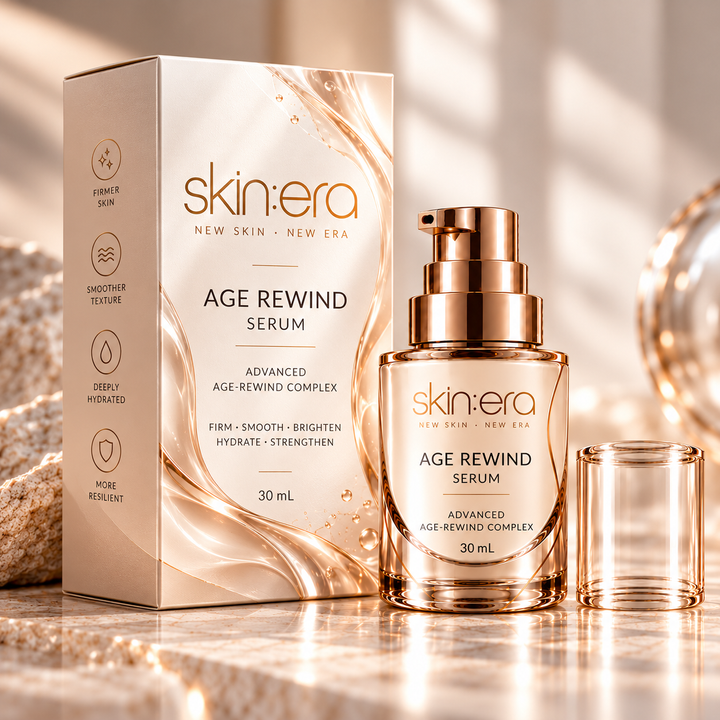
PDRN in SKINERA AGE REWIND SERUM
SKINERA AGE REWIND SERUM is designed as an advanced daily anti-ageing serum incorporating PDRN as part of a broader multi-active formulation.
Its role is not to rely on one hero ingredient alone.
Instead, AGE REWIND is designed to support:
- firmer-looking skin
- smoother texture
- hydration
- resilience
- a more refined, youthful-looking complexion
Explore SKINERA AGE REWIND SERUM:
How to Use PDRN in a Daily Routine
For morning use:
Cleanse → SKINERA AGE REWIND SERUM → SKINERA AGE DEFEND FLUID SPF50+ PA++++
For night use:
Cleanse → SKINERA AGE REWIND SERUM → SKINERA AGE RESTORE CRÈME — NIGHT SHIFT
This creates a simple structure:
Morning = Treat + Protect
Night = Treat + Restore
PDRN Is Promising — But Formulation Still Matters
The growing interest in PDRN is supported by increasingly sophisticated research.
At the same time, researchers continue to highlight limitations in the existing evidence, including differences between formulations, delivery methods and study designs.
This is why the presence of PDRN alone should not be the only reason to choose a skincare product.
A strong anti-ageing product should combine:
the right ingredient + the right formulation + consistent use + daily UV protection.
The Bottom Line
So, what does PDRN actually do?
Current research suggests that PDRN may support biological processes associated with skin quality and may contribute to smoother, firmer and more resilient-looking skin.
It is particularly interesting for anti-ageing formulations focused on:
- texture
- firmness
- fine lines
- skin resilience
- overall skin quality
But PDRN is not magic, and topical PDRN research is still evolving.
Its greatest value is likely to come when it is used as part of a complete, carefully designed skincare system rather than as a standalone trend ingredient.