
How to Choose an Anti-Ageing Serum for Firmer, Smoother-Looking Skin
Choosing an anti-ageing serum can be confusing.
There are hundreds of products claiming to improve firmness, smoothness, hydration, fine lines and overall skin quality.
But not every serum is designed the same way.
The best anti-ageing serum is not simply the one with the longest ingredient list or the highest percentage of actives.
What matters most is how well the formulation addresses the visible changes associated with ageing skin.
What Happens to Skin as It Ages?
As skin ages, several changes may occur at the same time.
These can include:
- reduced firmness
- lower elasticity
- increased dryness
- more visible fine lines
- uneven texture
- slower-looking skin renewal
- reduced resilience
- dullness
This means effective anti-ageing skincare often needs to address more than one concern.
A serum that focuses on only one pathway may still be useful, but a broader formulation may offer more complete support.
Look for Ingredients That Support Firmness
Firmness is closely linked to the structural support of the skin.
Collagen, elastin and the surrounding extracellular matrix all contribute to how firm and resilient skin appears.
When choosing a serum, look for ingredients designed to support the appearance of skin structure and elasticity.
Examples may include:
- PDRN
- peptides
- bakuchiol
- niacinamide
- selected antioxidant systems
The goal is not to “lift” the skin instantly.
Instead, the serum should support a smoother, firmer and more resilient-looking appearance over time.
Look for Ingredients That Support Smoothness
Skin can appear rougher with age because of:
- dehydration
- uneven surface texture
- barrier changes
- environmental stress
- slower renewal
A good anti-ageing serum should therefore support skin smoothness as well as firmness.
Ingredients that help maintain hydration and surface comfort can make the skin appear more refined.
Hydration Is Essential
Hydration is one of the most important factors in how youthful skin looks.
When skin becomes dehydrated:
- fine lines may appear more visible
- texture may look rougher
- skin may feel tight
- radiance may decrease
A well-formulated anti-ageing serum should include ingredients that help attract and retain moisture.
Examples may include:
- hyaluronic acid
- glycerin
- panthenol
- ectoin
- humectant complexes
Hydration does not replace anti-ageing actives.
But it helps create the conditions for skin to look smoother, plumper and healthier.
Do Not Ignore the Skin Barrier
The skin barrier helps reduce water loss and protects the skin from external stress.
A weakened barrier can make ageing skin appear:
- dry
- rough
- dull
- less comfortable
- more reactive
This is why barrier-supporting ingredients can be valuable in an anti-ageing serum.
Ceramides and other barrier-supporting components may help maintain a more balanced skin environment.
Antioxidant Support Matters
Environmental stress contributes to visible ageing.
UV exposure, pollution and oxidative stress can affect skin structure and appearance over time.
Antioxidant ingredients can help support the skin against oxidative stress.
Examples may include:
- vitamin C derivatives
- acetyl zingerone
- botanical antioxidants
- antioxidant complexes
Antioxidants should be considered part of a broader strategy rather than a complete anti-ageing solution on their own.
Consider Advanced Ingredients Like PDRN
PDRN has become increasingly popular in advanced skincare.
It is composed of DNA-derived nucleotide fragments and has been studied in relation to biological pathways associated with tissue quality and recovery.
In topical skincare, PDRN is being explored for its potential role in supporting:
- firmer-looking skin
- smoother texture
- resilience
- overall skin quality
For more detail, read:
What Is PDRN in Skincare? Benefits, How It Works & Who It’s For
You can also read:
PDRN for Skin: What Does It Actually Do?
What About Exosome Technology?
Exosomes are another emerging area in advanced skincare.
They are extracellular vesicles involved in cell-to-cell communication.
Researchers are studying their potential role in:
- skin rejuvenation
- extracellular-matrix signalling
- skin resilience
- texture
- visible ageing
For a deeper explanation, read:
What Are Exosomes in Skincare?
You can also read:
PDRN + Exosome Skincare: Why Are They Used Together?
Do Not Choose a Serum Based on One Ingredient Alone
A common mistake is choosing a serum only because it contains one trending ingredient.
A product may contain PDRN, peptides, exosomes or another advanced active, but the complete formulation still matters.
A strong anti-ageing serum should ideally consider several dimensions:
- firmness
- elasticity
- hydration
- smoothness
- barrier support
- antioxidant protection
- skin resilience
This is why formulation architecture matters more than ingredient hype.
More Actives Do Not Always Mean Better
A longer ingredient list does not automatically mean better performance.
Too many actives can sometimes make a formula more complicated without improving the user experience.
What matters is:
- ingredient compatibility
- suitable concentrations
- stability
- delivery
- skin tolerance
- overall formula balance
A focused, well-designed active system can be more meaningful than an overloaded formulation.
Concentration Matters — But It Is Not Everything
Consumers often compare serums by percentage.
This can be useful, but it is not the whole story.
The effectiveness of an ingredient may also depend on:
- raw-material quality
- active concentration versus supplied-material concentration
- formulation stability
- delivery system
- pH
- compatibility with other ingredients
This is especially important with advanced ingredients such as PDRN and exosome-related materials.
A large percentage on a label does not automatically mean better performance.
Texture and Wearability Matter
A serum can only work as part of a routine if people are willing to use it consistently.
Texture therefore matters.
A good daily anti-ageing serum should ideally feel:
- lightweight
- comfortable
- easy to layer
- non-greasy
- compatible with moisturiser
- compatible with sunscreen
- suitable under makeup
A technically sophisticated serum that is unpleasant to use may lead to inconsistent application.
Consistency is one of the most important parts of skincare.
Check Whether the Serum Works Morning and Night
A versatile serum can often fit into both morning and night routines.
For morning, it should layer comfortably under sunscreen.
For night, it should work well under a moisturiser or night cream.
This can make the routine simpler and easier to maintain.
Choose a Serum That Fits Your Main Concerns
Different people may prioritize different concerns.
If your main concern is firmness, look for a formula designed around structural support and elasticity.
If your main concern is dehydration, prioritize strong hydration and barrier support.
If your main concern is fine lines, look for a formula combining hydration with ingredients that support overall skin quality.
If your concerns overlap, a multi-active serum may be more appropriate.
When Should You Start Using an Anti-Ageing Serum?
There is no universal age at which everyone must start.
Skin ageing is influenced by:
- genetics
- sun exposure
- lifestyle
- environment
- sleep
- skincare habits
For many people, prevention and maintenance become increasingly relevant from the late twenties and thirties onward.
But the best time to begin is when the concerns become relevant to you.
How Long Does an Anti-Ageing Serum Take to Work?
Some effects can be visible quickly.
For example, better hydration may make skin appear:
- plumper
- smoother
- fresher
Other changes take longer.
Improvements related to:
- texture
- firmness
- elasticity
- visible fine lines
usually require consistent use over time.
Anti-ageing skincare should therefore be evaluated over weeks and months rather than days.
Why Sunscreen Is Non-Negotiable
One of the biggest mistakes is investing in an advanced anti-ageing serum while neglecting daily sunscreen.
UV exposure contributes significantly to visible skin ageing.
It can affect:
- collagen
- elasticity
- pigmentation
- texture
- fine lines
So even the best serum should be paired with daily broad-spectrum sun protection.
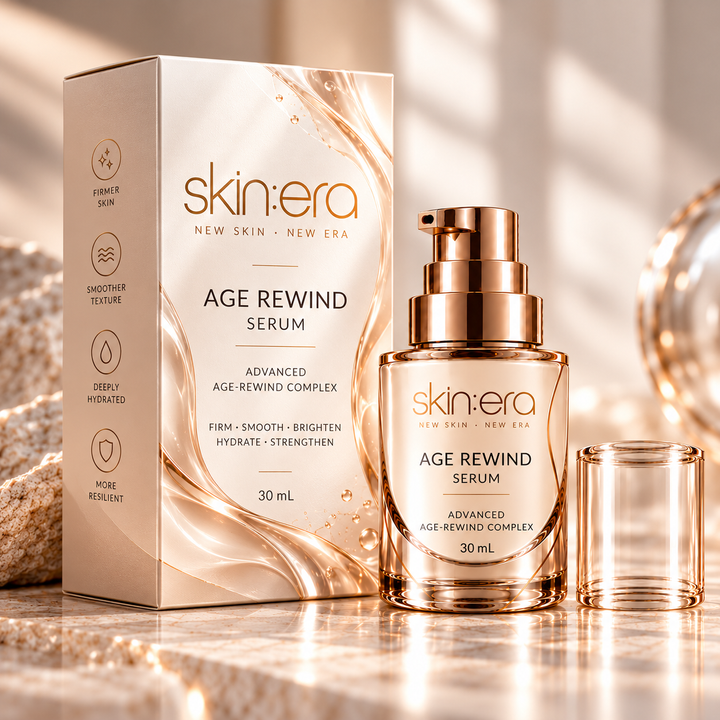
SKINERA AGE REWIND SERUM
SKINERA AGE REWIND SERUM is designed as an advanced multi-active anti-ageing serum.
Its formulation direction is built around supporting:
- firmness
- smoothness
- hydration
- elasticity
- skin resilience
- a refined, youthful-looking appearance
PDRN and exosome technology form part of the broader active system, alongside complementary ingredients selected to support multiple visible dimensions of skin ageing.
Explore SKINERA AGE REWIND SERUM:
How to Build a Complete Routine Around Your Serum
For morning:
Cleanse → SKINERA AGE REWIND SERUM → SKINERA AGE DEFEND FLUID SPF50+ PA++++
For night:
Cleanse → SKINERA AGE REWIND SERUM → SKINERA AGE RESTORE CRÈME — NIGHT SHIFT
This keeps the routine simple:
Morning = Treat + Protect
Night = Treat + Restore
The Bottom Line
Choosing an anti-ageing serum should not be about chasing the newest ingredient.
The strongest choice is a serum that addresses the concerns that matter most to your skin.
Look for a formulation that supports:
- firmness
- elasticity
- hydration
- smoothness
- barrier function
- resilience
Then consider practical factors such as texture, stability, compatibility and consistency of use.
A well-formulated anti-ageing serum should not simply sound advanced.
It should fit naturally into a complete skincare routine that you can maintain every day.