
Skin Elasticity: What Causes Skin to Lose Firmness?
Skin elasticity is one of the qualities most closely associated with a youthful-looking complexion.
When skin has good elasticity, it appears:
- firmer
- smoother
- more resilient
- more supple
As skin ages, however, this elasticity gradually declines.
That is why skin may begin to look less firm, less lifted and more prone to visible lines.
But what actually causes this change?
What Is Skin Elasticity?
Skin elasticity refers to the skin’s ability to stretch and return to its original shape.
This quality depends on several structural and functional components within the skin.
Two of the most important are:
- collagen
- elastin
Collagen provides structural support and strength.
Elastin helps skin stretch and return to shape.
Together, they contribute to the skin’s firmness, flexibility and resilience.
Why Does Skin Lose Firmness With Age?
Ageing affects the skin in several ways at the same time.
Over time, the skin may experience:
- reduced collagen production
- changes in elastin
- slower skin renewal
- reduced moisture retention
- cumulative UV damage
- oxidative stress
- changes in the extracellular matrix
These changes can gradually reduce the skin’s ability to maintain firmness and elasticity.
What Happens to Collagen as Skin Ages?
Collagen is one of the main structural proteins in the skin.
It helps create the framework that supports firmness and density.
As we age, collagen production naturally declines.
Existing collagen can also become fragmented and less organized.
This may contribute to:
- visible fine lines
- reduced firmness
- thinner-looking skin
- loss of structural support
- uneven texture
This is why collagen-related support is an important part of anti-ageing skincare.
What Happens to Elastin?
Elastin is responsible for much of the skin’s ability to stretch and return to shape.
Unlike collagen, elastin fibres have a highly flexible structure.
With ageing and repeated environmental exposure, elastin can become less organized and less efficient.
This can contribute to skin that appears:
- less firm
- less springy
- less resilient
- more prone to sagging
How Does UV Exposure Affect Skin Elasticity?
UV exposure is one of the most important external factors affecting visible skin ageing.
Repeated UVA exposure can affect the deeper structural components of the skin.
Over time, this may contribute to:
- collagen breakdown
- changes in elastin
- uneven pigmentation
- fine lines
- loss of firmness
- photoageing
This is why daily sunscreen is not only about preventing sunburn.
It is also one of the most important steps for protecting the appearance of skin firmness over time.
What Is Photoageing?
Photoageing refers to visible skin ageing caused or accelerated by long-term UV exposure.
It can appear as:
- fine lines
- wrinkles
- uneven tone
- rough texture
- reduced elasticity
- loss of firmness
Chronological ageing happens naturally.
Photoageing adds another layer of stress to the skin.
This is why two people of the same age may show very different levels of visible skin ageing depending on their UV exposure and protection habits.
Does Dehydration Make Skin Look Less Firm?
Yes.
Hydration does not directly replace collagen or elastin, but it strongly affects how firm and smooth the skin appears.
When skin is dehydrated, it may look:
- flatter
- rougher
- less plump
- less radiant
- more lined
Fine lines can also appear more visible.
Well-hydrated skin tends to look fuller and smoother, which can improve the overall appearance of firmness.
Does the Skin Barrier Affect Elasticity?
Indirectly, yes.
The skin barrier helps prevent excessive water loss.
When the barrier is compromised, skin may become:
- dry
- tight
- rough
- irritated
- dehydrated
This can make ageing concerns appear more noticeable.
Supporting the skin barrier therefore helps maintain the conditions needed for skin to look smoother, more comfortable and more resilient.
What Role Does the Extracellular Matrix Play?
The extracellular matrix is the structural network surrounding skin cells.
It contains components such as:
- collagen
- elastin
- glycosaminoglycans
- other structural proteins
This network plays an important role in skin strength, flexibility and support.
Ageing, UV exposure and oxidative stress can influence the quality of the extracellular matrix.
That is why advanced anti-ageing skincare often focuses on more than surface hydration alone.
Can Skincare Improve Skin Firmness?
Skincare cannot completely reverse the biological ageing process.
However, a well-designed routine may help improve the appearance of firmness and overall skin quality.
Useful approaches may include:
- maintaining hydration
- supporting the skin barrier
- using ingredients associated with collagen and skin-quality support
- antioxidant care
- protecting skin from UV exposure
- using products consistently
Visible changes usually depend on both the ingredients and how consistently they are used.
Which Ingredients Can Support Firmer-Looking Skin?
Different ingredients may support different aspects of ageing skin.
Examples include:
- PDRN
- peptides
- bakuchiol
- niacinamide
- panthenol
- ectoin
- ceramides
- hyaluronic acid
- antioxidants
No single ingredient needs to perform every function.
A well-designed anti-ageing formula can combine complementary ingredients to address multiple concerns at once.
What Is the Role of PDRN?
PDRN has attracted growing interest in modern skincare.
Research has explored PDRN in relation to biological pathways associated with tissue quality, cellular activity and extracellular-matrix support.
In topical skincare, this has created interest in its potential role in supporting:
- firmer-looking skin
- smoother texture
- resilience
- overall skin quality
For more detail, read:
What Is PDRN in Skincare? Benefits, How It Works & Who It’s For
You can also read:
PDRN for Skin: What Does It Actually Do?
Can Exosome Technology Support Skin Firmness?
Exosome technology is another emerging area of skincare research.
Exosomes are extracellular vesicles involved in cell-to-cell communication.
They are being studied for their potential role in processes related to:
- skin quality
- extracellular-matrix signalling
- resilience
- visible rejuvenation
For more detail, read:
What Are Exosomes in Skincare?
Why PDRN and Exosomes May Be Used Together
PDRN and exosomes are not the same.
They represent different approaches to advanced skincare.
PDRN is associated with nucleotide-derived biological support.
Exosomes are associated with cell-to-cell signalling.
This creates interest in combining them within multi-active formulations designed to support several aspects of ageing skin.
Read:
PDRN + Exosome Skincare: Why Are They Used Together?
How Important Is Sunscreen for Skin Firmness?
Extremely important.
If the goal is to maintain firmer-looking skin, daily UV protection should be considered foundational.
A strong anti-ageing routine should therefore combine:
Treatment + Protection
In the SKINERA routine:
Morning: Cleanse → SKINERA AGE REWIND SERUM → SKINERA AGE DEFEND FLUID SPF50+ PA++++
What About Night-Time Skincare?
Night is an important time for hydration and skin-conditioning support.
A night routine can help maintain:
- moisture
- comfort
- barrier function
- smoother texture
- plumper-looking skin
The SKINERA night routine is:
Cleanse → SKINERA AGE REWIND SERUM → SKINERA AGE RESTORE CRÈME — NIGHT SHIFT
How to Choose a Serum for Firmer-Looking Skin
When choosing an anti-ageing serum, look beyond one individual ingredient.
Consider whether the formulation supports:
- firmness
- elasticity
- hydration
- smoothness
- barrier function
- skin resilience
Also consider whether the serum is easy to use consistently.
For a complete guide, read:
How to Choose an Anti-Ageing Serum for Firmer, Smoother-Looking Skin
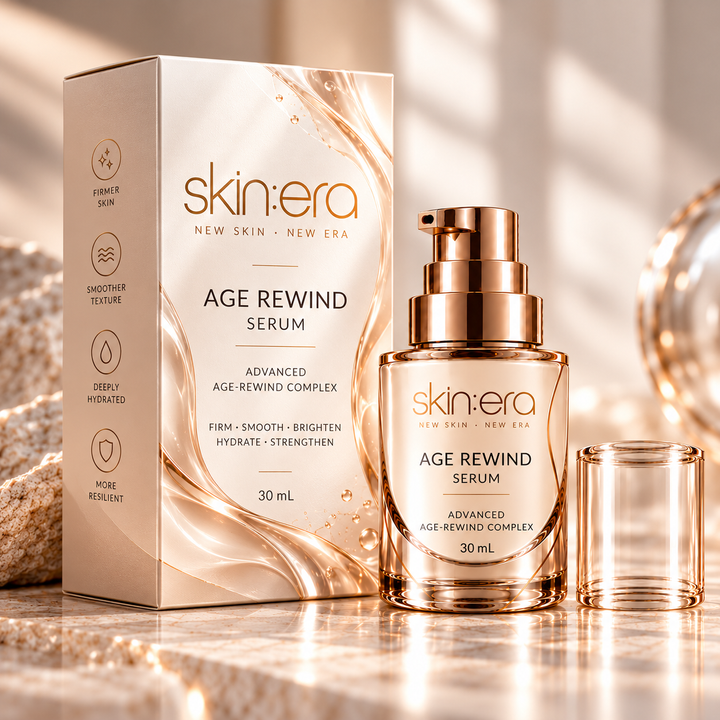
SKINERA AGE REWIND SERUM
SKINERA AGE REWIND SERUM is designed as a multi-active anti-ageing serum focused on supporting several visible dimensions of ageing skin.
Its formulation direction includes support for:
- firmness
- elasticity
- smoothness
- hydration
- skin resilience
- a more refined and youthful-looking appearance
PDRN and exosome technology form part of the broader active system.
Explore SKINERA AGE REWIND SERUM:
Can Skin Elasticity Be Maintained Forever?
No skincare routine can stop ageing completely.
Skin will continue to change over time.
But daily habits can influence how quickly visible ageing develops.
Important habits include:
- protecting skin from UV exposure
- maintaining hydration
- supporting the skin barrier
- using suitable anti-ageing ingredients
- avoiding unnecessary irritation
- staying consistent
The goal is not to prevent ageing.
The goal is to support skin so that it continues to look healthy, resilient and well cared for as it changes.
The Bottom Line
Skin elasticity depends on more than one factor.
Collagen, elastin, hydration, barrier function, environmental exposure and biological ageing all influence how firm and resilient the skin appears.
Loss of firmness is therefore not caused by one single problem.
The most effective skincare strategy is a complete one.
Support the skin.
Keep it hydrated.
Protect it from UV exposure.
Use well-formulated anti-ageing products consistently.
Over time, these habits can help maintain skin that looks smoother, firmer and more resilient.